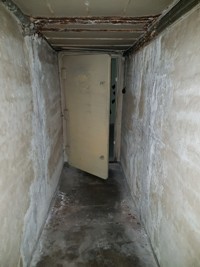
Photo. A door to a hidden Nazi treasure beneath Oslo Handelsgymnasium?
© Travel Explorations.
Around the Oslofjord are dozens of wartime tunnels, observation bunkers, ammunition caves and former military installations. Some have been abandoned, sealed or largely forgotten. Others remain poorly documented. Together, they reveal a lesser-known side of Norway's wartime past. Some of them are:
The hidden Nazi Bunker beneath Oslo Handelsgymnasium
What lie beneath the busy streets of Oslo? For decades, few people knew that a forgotten World War II bunker was hidden deep below Oslo Handelsgymnasium. Four metres beneath the school, behind thick concrete walls and heavy steel doors, lies a relic from one of the darkest periods in Norwegian history.
As Nazi Germany began to collapse in 1945, rumours spread across Europe. Gold, artwork, secret documents, and other treasures looted during the war were hidden away in tunnels, bunkers, and underground chambers. Could one of those secrets have found its way beneath this school in central Oslo? So far no evidence has emerged linking the bunker to hidden wartime treasures, although speculation persists.
Mellom Bolæren – The island with a dark secret
At first glance, Mellom Bolæren looks like a peaceful island in the Oslofjord. Pine trees sway in the wind, small beaches line the shore, and the sea stretches towards the horizon. It is hard to imagine what happened here during the war.
In 1943, the Germans established a Soviet prisoner camp on the island. Prisoners were brought here and forced to work on military fortifications connected to nearby Østre Bolæren, where the main Bolærne Fort was located. Many suffered from hunger, disease, and brutal conditions. Today, the island feels calm and untouched. Yet beneath the beauty lies a forgotten story of hardship and survival.
The hidden military hospital in Oslo
Few people walking through modern Oslo realize that Aker Hospital played an important role during the occupation. The Germans took over the hospital and turned it into Sinsen Kriegslazarett, a large military hospital for wounded soldiers.
But one discovery has raised more questions than answers. According to reports investigators found what appears to have been a jail or detention area hidden within the underground complex. Here are also believed that the complex hide several secret underground chambers and tunnels (source: the Norwegian Magazine Vi Menn, article written by Johnny Haglund).
Why would a military hospital need prison cells? Who was held there? German soldiers facing punishment? Resistance members? Allied prisoners? Or people whose stories were never recorded?
The complex expanded with barracks, storage buildings, shelters, and tunnels. Parts of the hospital infrastructure were protected underground, reflecting fears of future air raids.
Berg – Norway's forgotten camp
Just outside Tønsberg stands one of the most important yet least visited WWII sites in Norway. Berg Interneringsleir was used to imprison political opponents, resistance members, and Norwegian Jews. Many of those held here were later deported to Nazi concentration camps. What makes Berg particularly significant is its connection to Norwegian collaboration during the occupation. The camp became part of one of the darkest chapters in Norwegian history. Today, little remains to reveal the suffering that once took place here, making it easy to pass by without understanding its importance.
Møvik Fort – The giant watching the Sea
On a rocky hillside near Kristiansand stands one of the largest coastal guns built by Germany during the war. The enormous Krupp gun at Møvik Fort was designed to operate alongside a similar battery at Hanstholm in Denmark. Together, they helped control access to the Skagerrak and monitor shipping moving between the North Sea and the Baltic. Standing beside the gun today offers a striking reminder of the scale of Germany's military investment in occupied Norway.
Austrått Fort – A battleship inside a mountain
Few places feel more unusual than Austrått Fort. The Germans took a triple gun turret from the battleship Gneisenau and installed it inside a mountain overlooking the Trondheim Fjord. Hidden tunnels, underground rooms, and thick concrete defenses still remain. Walking through the fortress feels less like visiting a museum and more like exploring a lost underground world.
Falstad – The silent forest
Some places are difficult to forget. Falstad in Levanger Municipality in Trøndelag, served as a prison camp for resistance fighters, political prisoners, and foreign captives. Nearby lies Falstad Forest, where more than 200 prisoners were executed during the war. Today the forest is quiet. Birds sing between the trees, and sunlight filters through the branches. Yet knowing what happened here changes the way you experience the landscape.
Oscarsborg – The Fortress that changed history
On the morning of 9 April 1940, a small Norwegian fortress faced one of the most powerful military forces in Europe. From Oscarsborg Fortress, Norwegian defenders opened fire on the German cruiser Blücher as it sailed up the Oslofjord. The ship sank, and the German advance towards Oslo was delayed. That delay proved crucial. Norway's royal family, government, parliament, and gold reserves were able to escape before German forces arrived. Today, visitors can walk through the fortress, explore its tunnels, and stand where a small group of defenders changed the course of Norwegian history.
Exploring Norway's wartime landscapes
These places are more than military relics. They tell stories of occupation, courage, resistance, hardship and survival. For travellers who enjoy combining history with the outdoors, they offer a perspective rarely found at more heavily visited attractions. They encourage us to look beyond the best-known landmarks and explore places where the past remains close to the surface.
Norway's forests, islands and mountains still conceal many traces of the war. Sometimes the most rewarding journeys lead not to famous monuments, but to quieter places where history has not entirely disappeared.
Stein Morten Lund, June 2026
Additional information
Author's Note: This article was written with the assistance of ChatGPT and reviewed and edited by the author.
Read more about wartime history, historical mysteries and hidden sites around the world on Travel Explorations.
What is hidden beneath Książ Castle?
At first sight, Książ Castle resembles something from a fairy tale. Rising above the forests of south-western Poland, its towers and terraces appear untouched by time.
Beneath the castle, however, lies a darker story. Hidden below the historic structure is a network of tunnels, chambers and underground passages excavated during the final years of the Second World War. Large sections of rock were carved out by forced labourers working in brutal conditions. Historians still debate the intended purpose of these underground works.
Why did Nazi Germany devote so much effort and resources to excavations beneath Książ Castle? The question remains one of the enduring mysteries of the war. Read more on Travel Explorations.







 E-mail this
 Print this