Transnistrian Rubles, Tiraspol, Transnistria
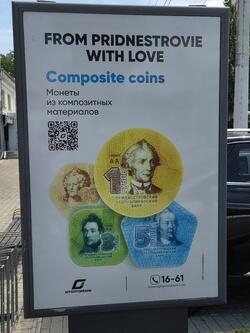
Photo. Transnistrian Rubles in different shapes, shown on a sign outside Transnistria's central bank, the Transnistrian Republican Bank.
© Travel Explorations.
Notice the text on the top of the sign: “From Pridnestrovie with love.” According to the Transnistrian authorities, the short name of the state is Pridnestrovie in Russian.
What makes it so surreal is that, because Transnistria isn't officially recognized as a country, its currency doesn't really exist to the rest of the world. You can't pay with a Visa card, and you can't exchange the money once you leave. Outside this narrow strip of land, it's completely worthless.
You cannot use Visa cards in Transnistria. Due to international sanctions, Western credit and debit cards (including Visa and Mastercard) do not work in the region. ATMs will not accept them, and merchants cannot process them. Because of this payment restriction, you must bring cash in Euros, US Dollars, or Moldovan Lei (MDL). You can exchange these currencies at banks or authorized exchange offices in Tiraspol for Transnistrian Rubles, which are the only accepted currency for daily purchases.
Transnistria has its own central bank, the Transnistrian Republican Bank, which issues its national currency, the Transnistrian ruble. One of the more unusual stops on my journey through Transnistria was the headquarters of the Transnistrian Republican Bank. Despite its uncertain international status, Transnistria maintains many of the institutions of an independent state, including its own central bank, which issues the Transnistrian ruble. Standing outside the building in Tiraspol, I found it remarkable that a territory recognized by most of the world as part of Moldova operates its own monetary system.
After a while I went inside the bank to take a look. Although visitors often exchange money to collect the distinctive plastic coins and banknotes as souvenirs, I decided not to withdraw any cash. Instead, I spent a few moments reflecting on what the bank represented. It was more than a financial institution. As I see it, it was a symbol of identity, sovereignty, and the region's desire to exist on its own terms.
Later someone gave me the opportunity to hold those colorful plastic coins. It felt like stepping into another reality. They didn't feel like ordinary money at all. They reminded me of board game pieces or casino tokens.
Transnistria is the only place in the world that issues plastic coins for everyday use. The 1, 3, 5, and 10 ruble coins are made from composite plastic and come in different shapes as round, square, pentagon, and hexagon. They brought back my memories of playing Monopoly as a kid.
As I examined the colorful pieces, memories of childhood Monopoly games came flooding back. It was one of those unexpected travel moments that makes a destination memorable, not a famous landmark or spectacular landscape, but a small, everyday object that tells a much larger story. In Transnistria, even paying for a cup of coffee can feel like stepping into a parallel world.
Stein Morten Lund, updated 18th July 2026
Additional information
Moldova is a small Eastern European country located between Romania to the west and Ukraine to the east. Known for its rolling countryside, vineyards, and rich cultural heritage, Moldova sits at a crossroads between Eastern and Western Europe. Despite its modest size, the country has a complex history shaped by centuries of shifting borders, empires, and political influences.
Within Moldova lies Transnistria, officially known as the Pridnestrovian Moldavian Republic (PMR) and locally as Pridnestrovie. It is a landlocked breakaway state that is internationally recognised as part of Moldova, although it has operated as a self-governing territory since the early 1990s. Transnistria controls most of the narrow strip of land between the Dniester River and the Moldova–Ukraine border, along with several areas on the opposite bank of the river. The region's capital and largest city is Tiraspol, which serves as its political, economic, and cultural centre. There, Soviet symbols remain visible, statues of Lenin still stand in public squares, and the atmosphere offers a rare glimpse into a world that has largely disappeared elsewhere in Europe.
Transnistria is known for its distinctive Soviet-era atmosphere, separate institutions, and unique political status, making it one of the most unusual and little-known regions in Europe.
According to the Transnistrian authorities, the short name of the state is Pridnestrovie in Russian, meaning "[land] by the Dniester". The Supreme Council passed a law on 4 September 2024 which banned the use of the term Transnistria within the region, imposing a fine of 360 rubles or up to 15 days imprisonment for using the name in public (source: Wikipedia).
Read more about Transnistria on Wikipedia.







 E-mail this
 Print this