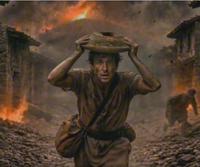
Screenshot from a short AI video. Researchers reconstructed a possible escape attempt by a man killed during the AD 79 eruption of Mount Vesuvius. © Università di Padova / Parco archeologico di Pompei.
This is not about replacing archaeology. It is about strengthening our emotional connection to the past and helping people visualise events that otherwise feel distant or abstract. At the same time, increasingly realistic AI-generated imagery forces us to ask difficult questions about where historical evidence ends and digital interpretation begins.
AI video and the new age of travel inspiration
Travel videos are becoming one of the strongest trends in online media, especially short cinematic videos designed for inspiration rather than traditional travel information. AI-generated historical films, reconstructions, and immersive travel videos are now appearing everywhere, from YouTube documentaries to museum installations and virtual tours.
One example comes from Pompeii, where researchers used AI-assisted reconstruction to visualise the possible face and final movements of a man killed during the eruption of Mount Vesuvius in AD 79. The scientific evidence as skeletal remains, ash layers, and archaeological analysis is real. AI simply helps transform fragments into something people can emotionally understand.
For travellers, that changes the experience of history. Ancient disasters stop feeling remote and begin to feel human.
Egypt offers another example. Researchers are using AI to analyse damaged inscriptions, study hidden chambers, and reconstruct how temples and tombs may once have appeared thousands of years ago.
Travel AI is also moving beyond route planning and hotel recommendations. It can guide visitors through reconstructed ancient streets, translate faded texts, recreate vanished structures, and show how landscapes may once have looked centuries ago.
AI-generated video is beginning to change how people imagine travel itself. Instead of simply presenting destinations, it creates atmosphere and emotional anticipation before a traveller even arrives. A short AI-enhanced sequence of sunrise over Machu Picchu, drifting sandstorms around Petra, or reconstructed Roman streets inside Pompeii can trigger curiosity in ways traditional brochures rarely manage.
Seeing history differently
What makes AI video compelling is not only realism, but atmosphere. It combines sound, movement, historical reconstruction, and storytelling into experiences that feel immersive rather than instructional. For many travellers, inspiration starts emotionally long before it becomes practical.
AI-generated travel content can also reveal perspectives that are otherwise impossible to experience:
- visualising how ancient cities may once have looked
- reconstructing lost civilisations or historical events
- simulating wildlife migrations and environmental change
- recreating inaccessible regions, deep oceans, deserts, or remote mountain areas
- encouraging travellers to look beyond mainstream tourism
For adventure travellers especially, this can make lesser-known places feel vivid and reachable. A forgotten Silk Road fortress, an abandoned Arctic settlement, or a jungle-covered temple suddenly feels less abstract and more real.
The danger of artificial perfection
There is, however, an obvious risk. AI-generated travel videos can become too polished and emotionally manipulative. Landscapes are exaggerated, colours intensified, crowds removed, and historical events dramatised to maximise emotional impact. Destinations can start looking more like fantasy than reality.
Travellers may then arrive expecting cinematic perfection instead of complicated, living places.
There is also the problem of historical accuracy. AI-generated scenes can easily blur the line between documented evidence and speculation without viewers fully realising it. A convincing reconstruction may feel factual even when parts of it are hypothetical.
Used responsibly, though, AI video has remarkable potential. It can introduce people to archaeology, history, remote landscapes, and cultures they might otherwise never explore. It can encourage curiosity instead of passive tourism.
Perhaps the best AI travel videos do not replace travel at all. They simply act as a spark and encouraging people to experience places for themselves. Because no simulation can reproduce the feeling of thin air at high altitude, desert silence after dark, or that almost surreal feeling of standing somewhere ancient and knowing it’s real beneath your feet.
Stein Morten Lund, May 2026
Additional information
You can watch AI-created historical films, reconstructions, and visual storytelling on several platforms today: from YouTube channels to museum projects and virtual tours.
Here are some of the best places to explore:
YouTube channels and creators
- Historic Reels AI YouTube Channel: AI-generated history videos covering ancient civilizations, wars, and historical events
- TIME Studios + Darren Aronofsky’s AI history series: The series On This Day… 1776 recreates American Revolution moments using AI-assisted filmmaking.
- AI documentary creators on YouTube Shorts and TikTok.
Many creators now use AI to generate historical scenes, narrations, and animations. Platforms like Woxo specialize in this type of content.
Virtual museums and historical experiences:
- AI-powered virtual museum tours like SeeMuseums let users explore collections interactively using AI-generated guidance and storytelling.
- The Vatican and Microsoft created an AI-generated digital twin of St. Peter’s Basilica that visitors can explore virtually.
- Museums focused on Holocaust history, slavery, and Indigenous history increasingly use AI, holograms, and VR to create immersive storytelling experiences.
Educational and cultural websites:
- Smarthistory offers high-quality videos and visual explanations about art history and ancient cultures. While not fully AI-generated, it increasingly uses digital and interactive presentation methods.
- AI video generators like HeyGen, Mootion, Pippit, Imagine.art, and Reelmind allow creators to build historical documentaries and recreations.
- AI art and historical reconstruction projects
- Artists like Refik Anadol create AI-generated visualizations using historical archives and museum collections
- AI-generated “lost artifacts” and speculative ancient objects are explored in projects like Babylonian Vision.
My view is that the most interesting use of AI in history is not replacing historians, but enhancing imagination and accessibility. AI can:
- reconstruct destroyed cities
- animate historical figures
- restore damaged photos and films
- create immersive museum experiences
- help younger generations engage with history
But there is an important balance:
AI-generated history should always clearly separate:
- verified facts
- scientific reconstruction
- artistic interpretation
Otherwise people may confuse fictional reconstructions with actual evidence.
The best projects use AI as a visualization tool guided by historians, archaeologists, artists, and educators, and not as an automatic “truth machine.”







 E-mail this
 Print this